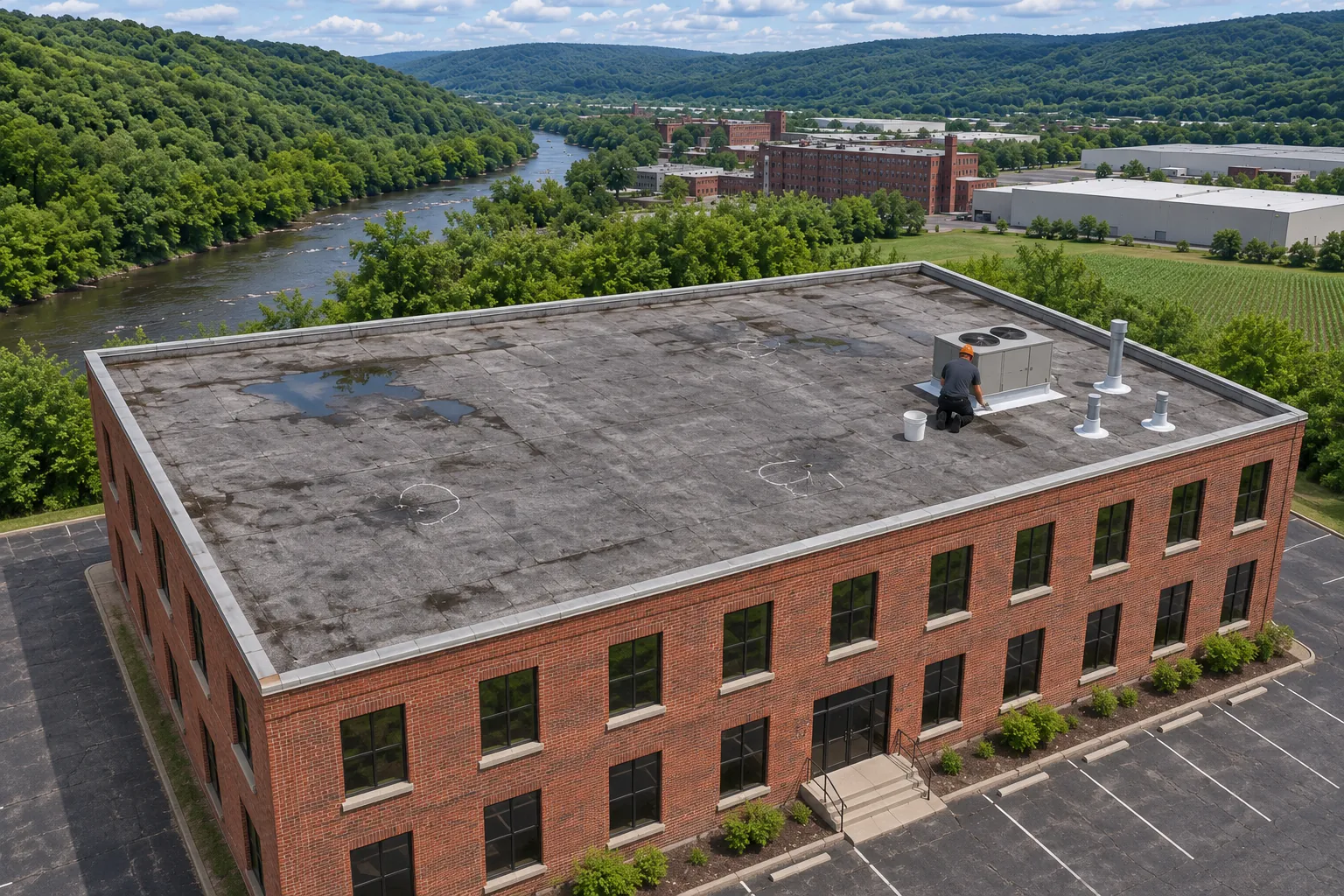
Roofer kneeling at a rooftop unit on a brick building, with marked points around the roof penetrations
FAQ

Commercial Roof Repair Questions in Scranton

Thirty Answers About Leaks, Seams, Drains, And Panels

Here are plain answers to commercial roof repair questions in Scranton, grouped by roof type and problem so you can jump to yours.

All Questions

Answers To Commercial Roof Repair Questions in Scranton

These commercial roof repair questions in Scranton come from owners, tenants, and facility managers. Pick a topic below.

Roof Damage

Responding To Roof Damage

Hail, sudden leaks in occupied space, pricing, and what a leak investigation covers beyond the stain on the ceiling.

How should hail damage on a Scranton commercial roof be assessed?

Hail damage should be assessed for punctures, opened seams and affected flashing rather than defined by visible dents alone. We inspect the roof alongside its earlier condition and any accompanying summer wind damage. The repair scope should describe functional defects, while insurance coverage remains dependent on the policy and the cause of the loss.

What should happen when water enters an occupied retail center?

An occupied retail center should protect people and contents and restrict affected areas while the water source is investigated. We gather the timing, location and equipment context before arranging safe roof access. Temporary containment can manage the immediate exposure, but a permanent repair still needs a diagnosed entry path and an assessment of damaged materials.

What establishes the price for a Scranton commercial roof repair?

An on-roof inspection establishes the repair price for the Scranton building. We examine leak tracing, roof system, damaged area sizes and number, wet insulation through core cuts, flashing, drains and access. The findings also determine whether a localized repair or replacement of a section offers a sound response to the actual condition.

What should a local roof leak investigation include beyond the interior stain?

A leak investigation should include roof features and operating conditions that could explain how water reached the stain. We compare seams, drains, penetrations and possible equipment sources before defining the work. The visible interior location can be downstream of the entry, so a repair placed directly above it can miss the cause.

Flat Roofs

Flat Roof Conditions

Blisters near walkways, repairs in freezing weather, downpour leaks on warehouses, and ponding that starts below the membrane.

Is a blister near a roof walkway different from one away from traffic?

Traffic exposure can affect how a blister is assessed because a raised area can be more vulnerable to damage along a walkway. We identify the roof system and check splitting, stability and moisture before recommending treatment. Cutting without a suitable repair plan can create another opening rather than resolve the original condition.

Which conditions limit flat roof repairs during a freeze?

Ice, wet surfaces and material application limits can restrict permanent flat roof repairs during freezing conditions. We assess safe access and the environment needed for the selected repair to bond or cure. Temporary measures may be necessary until the roof can be prepared appropriately, with the unfinished permanent work identified clearly.

Why might a warehouse flat roof leak during a sudden downpour?

A sudden downpour can expose blocked outlets or weak seams and flashings as runoff accumulates. We examine the warehouse’s drainage path and any low areas before choosing where to repair. Water can enter away from the interior drip, so the investigation should connect the roof conditions with the actual route through the assembly.

Can repairing ponding require work beneath the roof membrane?

Ponding repairs can involve insulation shape, deck condition or drain elevation beneath the visible membrane. We identify why runoff remains and inspect the affected area for moisture damage before defining the work. A surface patch can close a hole, but it cannot change the geometry responsible for recurring water collection.

Metal Roofs

Metal Roof Details

Old pipe boots, hail on metal panels, the details behind repeat leaks, and leaking screw holes.

Why can an old metal roof pipe boot need more than added sealant?

An old pipe boot can need replacement or a corrected connection if its material, fit or attachment has failed. We inspect the surrounding panel and movement at the penetration before choosing the repair. Added sealant alone cannot make an unsuitable component fit the roof profile or restore deteriorated metal beneath its edge.

Can a metal roof remain repairable after a hailstorm?

A metal roof can remain repairable after hail when functional damage is localized and sound connections remain around it. We inspect punctures, laps, flashing and attachment rather than judge the scope from dent appearance. Panel replacement can be needed in selected areas, while the surrounding serviceable roofing can be evaluated for retention.

Which overlooked metal details can contribute to recurring roof leaks?

Fastener holes, concealed corrosion at laps and poorly fitted penetration flashing can contribute to recurring metal roof leaks. We inspect beneath questionable previous repairs where appropriate and examine adjoining connections. Continued service depends on those components and maintenance, so closing one visible opening does not establish the condition of the whole roof.

How should a leaking screw hole be assessed before a metal roof repair?

A leaking screw hole needs its surrounding metal, washer and underlying support assessed before repair. We establish whether a suitable fixing can restore attachment or whether a different detail or panel work is needed. Sealing over a screw that continues to move leaves the mechanical cause of leakage unresolved beneath the surface.

Water Entry

Finding Water-Entry Routes

Coping joints on brick mills, ice blockages, leaks that show only in heavy rain, and tracing water across a large warehouse.

Could coping joints cause leakage inside a Scranton brick silk mill?

Coping joints can admit water above roof flashing and contribute to leakage inside a brick silk mill. We inspect masonry, cap attachment and flashing terminations alongside the horizontal roof. The repair should address the confirmed entry path rather than assume a membrane defect simply because water appears near ceiling level.

How do ice blockages change a commercial roof’s leak pattern?

Ice blockages can redirect or hold meltwater against seams and flashing that see different exposure during ordinary rain. We inspect drains, gutters and roof edges after access is safe. Heavy wet snow also raises loading concerns for qualified assessment, while the leak repair needs to address the water path and affected roofing materials.

Does a leak that occurs only in severe rain still need repair assessment?

A severe-rain-only leak still needs assessment because water is entering through a defect or drainage-related weakness. We compare storm conditions with outlets, penetrations and wall connections around the affected area. Being dry in lighter weather does not confirm that the assembly remains watertight when runoff rises or wind drives water toward a vulnerable detail.

What helps trace a leak across a large distribution warehouse roof?

A roof sketch, interior leak map and timing records help trace water across a distribution warehouse. We compare those observations with seams, equipment and drainage, then investigate likely entry routes. Water can move through insulation or along decking, so the repair boundary should reflect the findings rather than the location of one ceiling drip.

Question About Your Own Roof?

Call and describe the leak, the roof type, and the building. A straight answer comes before any visit is booked.

Industrial Work

Industrial Repair Work

Separating roof openings from active workstations, drains above machinery, distant leak sources, and vibrating exhaust fans.

How should roof repairs above production be separated from active workstations?

Repairs above production should be separated according to the exposure created by opening the roof and the sensitivity of work below. We coordinate protection, material routes and any isolation windows before removal begins. The proposed sequence should identify those restrictions rather than assume a small exterior defect allows unrestricted activity underneath.

Which precautions belong in a drain repair above industrial machinery?

The drain fault, access needs and protection beneath the connection should be established before opening the roof above machinery. We inspect roofing attachment and the outlet while coordinating any necessary plumbing investigation. A clear sequence helps avoid exposing equipment without addressing the component that is actually responsible for the leakage.

Can industrial roof leaks originate far from the damaged interior area?

Industrial roof leaks can originate away from the affected interior area because water travels within the assembly. We compare roof features with moisture evidence and consider equipment-related sources before selecting repairs. The scope should follow the diagnosed route and wet material boundary, rather than assume the visible damage marks the only opening above.

Why inspect vibration when repairing roofing around an exhaust fan?

Vibration can stress an exhaust fan’s curb and flashing connection, contributing to repeated leakage. We examine attachment, movement and contaminated roof areas alongside the equipment’s operating condition. The repair can need coordination with fan servicing so new roofing is not immediately exposed to an unresolved mechanical problem at the same connection.

Building Use

Maintenance And Building Use

Leased roofs, humidity inside brick buildings, what staff should watch after a repair, replacement decisions, and repair paperwork.

Who is responsible for repair work on a leased Scranton roof?

Responsibility for a leased Scranton roof depends on the agreement’s repair, maintenance and notice provisions. We can document the defect and proposed work so the parties can review those obligations. Access and protection of affected areas should be coordinated while authorization is settled, without assuming ownership or occupancy alone resolves payment responsibility.

Can humidity inside an older brick building resemble roof leakage?

Humidity can produce condensation that resembles roof leakage inside an older brick building. We compare dampness with weather and operations, then inspect insulation, panel undersides and roof-to-wall details. A patch should address a confirmed roof defect, while moisture developing inside the assembly can need a separate ventilation or enclosure response.

What should maintenance staff watch after a commercial roof has been repaired?

Maintenance staff should watch for disturbed flashing, blocked outlets and new damage around service routes after repairs. We compare later leak reports with the repair map and equipment activity to understand what changed. Keeping those observations together helps distinguish a repaired connection needing attention from another defect created elsewhere on the roof.

When might a repair plan need to become a replacement plan?

Replacement deserves consideration when investigation finds widespread wet materials or deterioration that prevents dependable local connections. We compare the repair area with the condition of the remaining assembly before expanding the scope. A decision should reflect current roof findings, rather than repeat patches simply because the latest interior leak appears small.

What should Scranton roof repair paperwork explain about the work area?

Scranton repair paperwork should explain removal boundaries and the affected roof layers, including unresolved conditions below the covering. We use the inspection findings to describe what work is known and where further investigation is needed. Within Pennsylvania’s statewide UCC framework, the reviewing authority should receive that complete scope before the owner assumes requirements from a short repair label.

Nearby Towns

Town Repair Questions

Warehouse repair boundaries in Dunmore, panel fastenings in Carbondale, equipment leaks in Old Forge, drains in Archbald, and snowmelt in Blakely.

Can a Dunmore warehouse repair stop at the apparent edge of a ceiling stain?

A ceiling stain does not establish the repair boundary on a Dunmore warehouse roof. We investigate the source and the extent of moisture within the assembly before deciding where new work should connect. The right boundary must reach firm materials, even when that extends beyond the area that appeared wet from inside.

Why should Carbondale panel repairs include nearby fastening checks?

Nearby fastenings can share corrosion or movement with the damaged panel on a Carbondale roof. We inspect washer condition, holding strength and adjoining laps before defining the repair. A new detail needs reliable surrounding connections, rather than leave an adjacent fixing capable of reopening the water path beside the completed work.

Could an Old Forge equipment leak be unrelated to its roof flashing?

An Old Forge equipment leak can originate in mechanical components or condensate drainage instead of roof flashing. We compare leakage with operation and rainfall while inspecting curbs and service penetrations. The equipment trade may need to investigate its own water sources before a roof repair can be selected as the appropriate response.

What can cause an Archbald roof drain repair to need plumbing work?

An Archbald drain repair can need plumbing work when leakage originates in the outlet or piping below the roof connection. We assess those components alongside the membrane attachment and wet materials nearby. Coordinating the trades allows the work to correct the diagnosed fault rather than repeatedly patch roofing above a separate pipe problem.

Could trapped roof moisture keep a Blakely facility dripping after snowmelt ends?

Trapped roof moisture can continue dripping after snowmelt ends, even when the original entry route is no longer receiving water. We compare the Blakely facility’s leak timing with roof findings and investigate wet materials where indicated. The repair needs to distinguish retained moisture from an ongoing opening so neither the source nor the damaged assembly is overlooked.

More Commercial Roof Repair Questions in Scranton?

Call with the details of your roof. We answer on the phone and inspect when the roof needs it.

Call Us (570) 918-5770